
Operational bottlenecks in 3PL logistics don't just slow down fulfillment — they erode client trust, inflate costs, and push customers toward competitors. Missed SLAs, inventory discrepancies, and manual errors compound quickly across high-volume operations. The good news is that upgrading your warehouse management software (WMS) can reverse these trends with measurable results. This guide walks you through identifying root causes of inefficiency, selecting the right tools, executing a successful WMS upgrade, and tracking the KPIs that confirm real improvement. If you're a 3PL provider or logistics decision-maker, every section here is built for your specific operational reality.
Table of Contents
- Understanding the root causes of 3PL inefficiency
- Essential tools and requirements for 3PL success
- Step-by-step: Upgrading your 3PL logistics with warehouse management software
- Avoiding change management and implementation pitfalls
- Measuring results: The metrics that prove improvement
- A fresh perspective: Why software is only half the battle in 3PL improvement
- Unlocking the next level of 3PL logistics with WMSDirectory
- Frequently asked questions
Key Takeaways
| Point | Details |
|---|---|
| Optimize core KPIs | Focus on maintaining inventory accuracy above 99% and on-time delivery above 98% to drive logistics success. |
| Choose the right tools | Modern WMS and robust integration are foundational for 3PL efficiency and error reduction. |
| Plan for smooth implementation | Invest in training and change management to avoid 60% of typical upgrade failures. |
| Measure post-upgrade results | Track logistics cost, delivery speed, and accuracy monthly to ensure continuous improvement. |
Understanding the root causes of 3PL inefficiency
Most 3PL operations don't fail because of a single catastrophic mistake. They underperform because of accumulated friction: disconnected systems, manual data entry, poor order visibility, and reactive rather than proactive decision-making. These issues stack up silently until a client escalates or a quarterly review exposes the damage.
The numbers make this concrete. Inventory accuracy can fall below 99% and on-time delivery can drop to 88% without strong processes and the right technology in place. Best-in-class benchmarks tell a different story:
- Inventory accuracy: >99%
- On-time delivery: >98%
- Order accuracy: >99.5%
- Pick productivity: Measured in units per hour, tracked weekly
When these numbers slip, the cause is almost always traceable to one of three failure points: poor data flow between systems, lack of real-time order tracking, or a WMS that no longer matches the complexity of your operation. Outdated software forces warehouse staff to work around the system rather than with it, creating shadow processes that are invisible to management and impossible to audit.
"Operational improvement isn't about working harder. It's about removing the friction that forces your team to compensate for broken systems every single shift."
Misaligned WMS configurations are particularly damaging in multi-client 3PL environments. When a single platform has to support different billing rules, SKU structures, and SLA requirements across clients, any gap in configuration becomes a source of errors. Understanding common warehouse challenges specific to 3PL operations is the first step toward addressing them systematically rather than reactively.
One real-world case showed on-time delivery climbing from 88% to 98% after targeted process and software improvements. That 10-point swing represents not just better performance but retained clients, reduced penalty clauses, and a stronger competitive position. The root cause wasn't effort. It was the absence of systems that could surface problems before they became failures.
Essential tools and requirements for 3PL success
Once you've diagnosed root inefficiencies, the next step is to ensure you have the tools and foundation for improvement. Technology alone isn't enough, but without the right technology, even the best team will hit a ceiling.
Here's a practical overview of what a well-equipped 3PL operation needs:
| Component | What it does | Why it matters |
|---|---|---|
| Modern WMS | Manages inventory, orders, and labor | Core operational engine |
| API integrations | Connects WMS to TMS, ERP, and client systems | Eliminates manual data entry |
| Cloud deployment | Enables remote access and scalability | Supports multi-site and multi-client ops |
| Trained staff | Executes processes consistently | Technology only works if people use it correctly |
| Data quality controls | Validates inputs at every touchpoint | Prevents downstream errors |
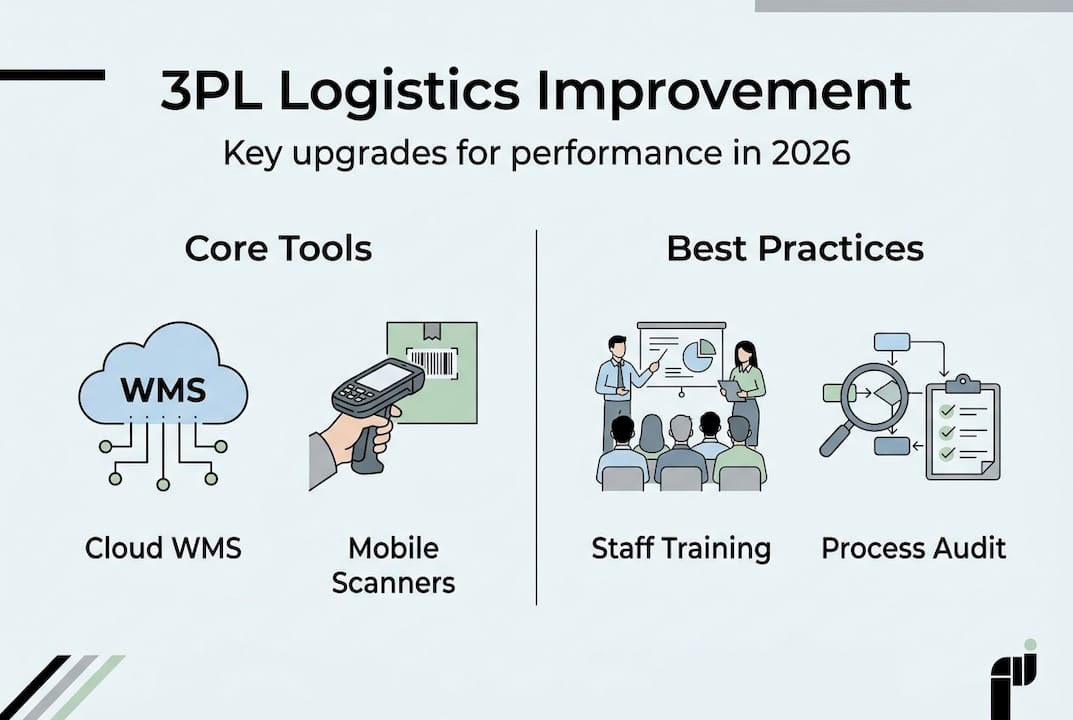
Cloud-based WMS platforms have become the standard for modern 3PLs because they support faster deployments, lower upfront costs, and easier integration with carrier networks and ecommerce platforms. API connectivity is non-negotiable if you're managing multiple client accounts with different tech stacks.

Beyond software, human factors matter just as much. Clear decision rights — knowing who owns inventory accuracy versus who owns pick productivity — prevent accountability gaps. Cross-functional teams that include warehouse supervisors, IT, and client account managers are far more effective at sustaining improvements than siloed departments.
Pick productivity improved by 15% in operations that invested in targeted software upgrades combined with staff retraining. That kind of gain doesn't happen from software alone.
Common 3PL roadblocks include poor system integration, undertrained staff, and lack of visibility into real-time inventory. Addressing these requires both the right warehouse software options and a deliberate readiness plan before any upgrade begins.
Pro Tip: Before committing to any WMS upgrade, run a readiness audit. Assess your current data quality, integration landscape, and staff training gaps. Upgrading into a broken foundation produces broken results.
Exploring top WMS solutions that are purpose-built for 3PL environments can significantly shorten your evaluation timeline and reduce the risk of selecting a platform that doesn't fit your operational model.
Step-by-step: Upgrading your 3PL logistics with warehouse management software
You're now equipped with the right foundation, so let's walk through the upgrade process step by step.
- Assess current state. Document your existing workflows, integration points, and KPI baselines. You can't measure improvement without a starting point.
- Define requirements. List must-have features: multi-client billing, real-time inventory, carrier integrations, reporting dashboards.
- Evaluate and select a vendor. Use structured scoring criteria. Involve warehouse supervisors and IT in demos, not just leadership.
- Plan data migration. Audit existing data for accuracy before migration. Clean data now prevents expensive fixes later.
- Configure and test. Run parallel testing with real order scenarios before go-live. Stress-test edge cases.
- Train staff. Role-specific training is more effective than generic sessions. Focus on daily workflows, not just system navigation.
- Go live with a pilot. Start with one client or one zone before full rollout.
- Review and iterate. Schedule a 30-day and 90-day post-go-live review against your baseline KPIs.
Choosing the right rollout approach matters as much as the steps themselves:
| Approach | Description | Best for |
|---|---|---|
| Big bang | Full cutover on a single date | Smaller operations, lower complexity |
| Phased | Roll out by client, zone, or function | Multi-client 3PLs, high-risk environments |
| Parallel run | Old and new systems run simultaneously | Operations that can't afford downtime |
60% of WMS implementations are delayed or go over budget due to poor planning and inadequate change management. Understanding implementation failure pitfalls before you start is the most cost-effective investment you can make.
Pro Tip: Involve key warehouse users from day one, not just at training time. Their input on workflow design prevents costly reconfigurations after go-live.
When selecting WMS platforms, prioritize vendors with proven 3PL-specific functionality and strong implementation support. Generic warehouse software often lacks the multi-client billing and client portal features that 3PL operations require. Review 3PL-specific WMS advice to narrow your shortlist faster.
Avoiding change management and implementation pitfalls
Even the best-laid plans need to overcome common pitfalls during WMS rollout. The most expensive mistakes rarely happen in the technology itself. They happen in how the change is managed.
The top failure patterns are consistent across 3PL implementations:
- Poor data migration: Migrating dirty data into a new system doesn't clean it. It just makes the new system unreliable from day one.
- Skipping end-user involvement: Warehouse staff who weren't consulted during design will find workarounds. Those workarounds become the new shadow process.
- Inadequate training: One-time training sessions don't stick. Ongoing reinforcement, especially in the first 90 days, is what drives adoption.
- No change champion: Without a visible internal advocate, resistance grows quietly and undermines adoption.
- Ignoring post-go-live support: The first two weeks after launch are the highest-risk period. Under-resourcing support during this window causes lasting damage to user confidence.
"Ignoring change management and skimping on training are two prime reasons for failed upgrades, regardless of how well the software itself was configured."
Post-go-live resistance is real and predictable. Staff who are comfortable with legacy processes will default to old habits under pressure. The solution isn't more enforcement. It's making the new system easier to use correctly than the old one was.
Reviewing change management best practices specific to WMS rollouts can help you build a communication and adoption plan that addresses resistance before it surfaces. The goal is to make your team feel like partners in the upgrade, not subjects of it.
Measuring results: The metrics that prove improvement
Once your upgrade is live, ongoing measurement is key to locking in gains and identifying new opportunities. Tracking the right KPIs transforms your WMS from a cost center into a performance engine.
Here are the metrics every 3PL should monitor monthly at minimum:
- Inventory accuracy rate: Target >99%. Measured via cycle counts and system-to-physical reconciliation.
- On-time delivery rate: Target >98%. Tracked per client and per carrier lane.
- Perfect order rate: Target >99.5%. Combines accuracy, completeness, and timeliness.
- Pick productivity: Units per labor hour. Baseline this before upgrade and track weekly post-launch.
- Logistics cost per order: Total fulfillment cost divided by order volume. A direct measure of operational efficiency.
- Returns processing time: Often overlooked but critical for ecommerce clients.
The results from well-executed upgrades are significant. Logistics cost per order dropped 12%, delivery speed increased 15%, and network capacity grew 100% following a structured WMS implementation. These aren't outlier results. They reflect what happens when software, process, and people improvements are aligned.
Benchmarking against industry leaders matters because it sets the right target. If your on-time delivery is at 94%, knowing that best-in-class is 98% tells you exactly how much runway exists. Without that context, 94% might feel acceptable.
Reviewing WMS outcomes for 3PL operations gives you a realistic picture of what improvements are achievable and over what timeframe. Set 30, 60, and 90-day review checkpoints to catch regressions early and celebrate measurable wins with your team.
A fresh perspective: Why software is only half the battle in 3PL improvement
Here's something most WMS vendors won't tell you: the software is the easy part. Selecting and deploying a modern WMS is a solvable, finite problem. The harder problem is cultural, and it doesn't come with a configuration menu.
The 3PL operations that sustain improvement over years share one trait that has nothing to do with technology. They build accountability into daily routines. Supervisors review KPIs every morning. Discrepancies are investigated, not just logged. Teams own their numbers.
Software can surface a pick error. It cannot create the culture where that error gets analyzed and prevented next time. That requires leadership commitment and a team that feels empowered to flag problems rather than hide them.
The most underrated lever in warehouse improvement is front-line empowerment. When pickers and receivers understand why accuracy matters and see their own metrics, performance improves without any system change at all. Pair that with the right deeper WMS strategies and you have a compounding advantage that competitors struggle to replicate.
Continuous improvement cycles beat set-and-forget upgrades every time. The 3PLs winning in 2026 aren't the ones with the newest software. They're the ones that never stop asking what's still broken.
Unlocking the next level of 3PL logistics with WMSDirectory
You now have a clear roadmap: diagnose inefficiencies, build the right foundation, execute a structured WMS upgrade, manage change proactively, and track the metrics that prove results. The next challenge is finding the right software partner for your specific operation.
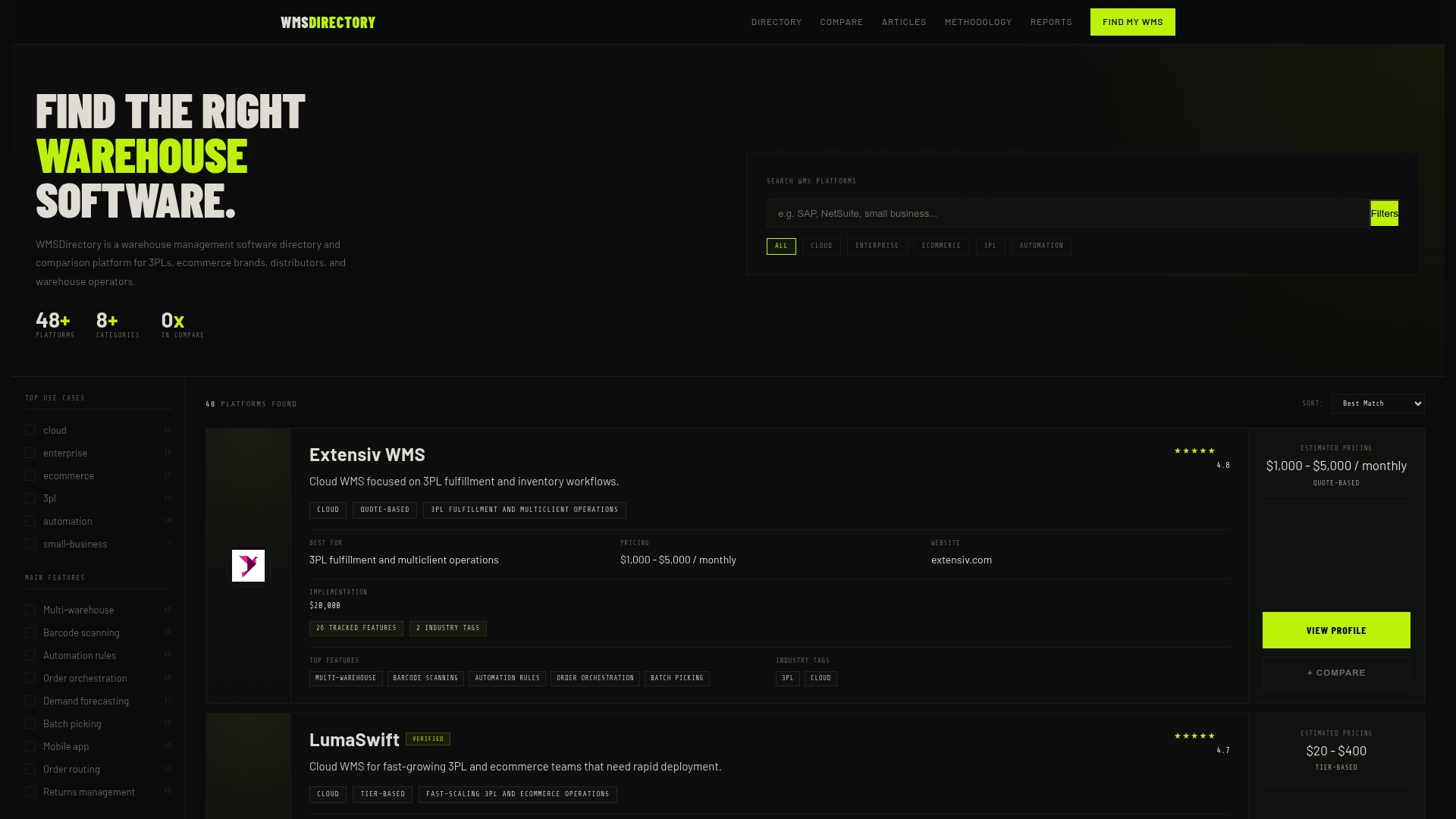
WMSDirectory simplifies that search. Instead of spending weeks on vendor calls and generic demos, you can compare top WMS for 3PL platforms side by side, filtered by deployment model, pricing structure, and 3PL-specific features. Our directory profiles are built for logistics decision-makers, not IT generalists. Explore the best 3PL WMS options available today and accelerate your path to measurable operational improvement.
Frequently asked questions
What are the most important KPIs for 3PL logistics improvement?
Focus on inventory accuracy above 99%, on-time delivery above 98%, and a perfect order rate near 99.5% as your core benchmarks for best-in-class performance.
How can I avoid WMS implementation failure in 3PL operations?
Defining clear requirements, involving warehouse users early, and investing in structured training are essential. 60% of implementations are delayed or over budget primarily due to poor data migration and inadequate change management.
How soon should I expect results after upgrading my 3PL warehouse management software?
Key metrics like cost per order and delivery speed are typically measurable within 3 to 6 months after a successful go-live, with accuracy improvements often visible within the first 30 days.
Is cloud or on-premise WMS better for 3PL logistics improvement?
Cloud WMS is generally preferred for 3PL environments because it offers faster deployment, easier integration with client systems, and the scalability needed to support multi-client growth.
What step is most often missed when improving 3PL logistics?
Most 3PLs underinvest in post-go-live KPI tracking and ongoing change management, both of which are critical for sustaining the gains achieved during initial implementation.